The Vault Gazette
How Assessing Comic Books with ComiCollector Actually Works
A collector-focused look at how ComiCollector helps turn comic details, condition, market evidence, and collection context into a smarter assessment.
Anyone who has spent time buying, selling, grading, or collecting comics knows that “What’s it worth?” is rarely a one-number question.
A high-grade raw copy is not the same thing as a mid-grade copy. A CGC 9.8 belongs in a different conversation from an ungraded book. A newsstand copy, variant, reprint, or different volume can completely change which market evidence actually matters.
And sometimes the exact comparable sale or listing you want simply does not exist.
That is the problem ComiCollector was built to tackle. It combines comic cataloguing, market research, comparable evidence, collector-focused analysis, and collection management in one app built by a collector for collectors.
It starts with the big blue plus button
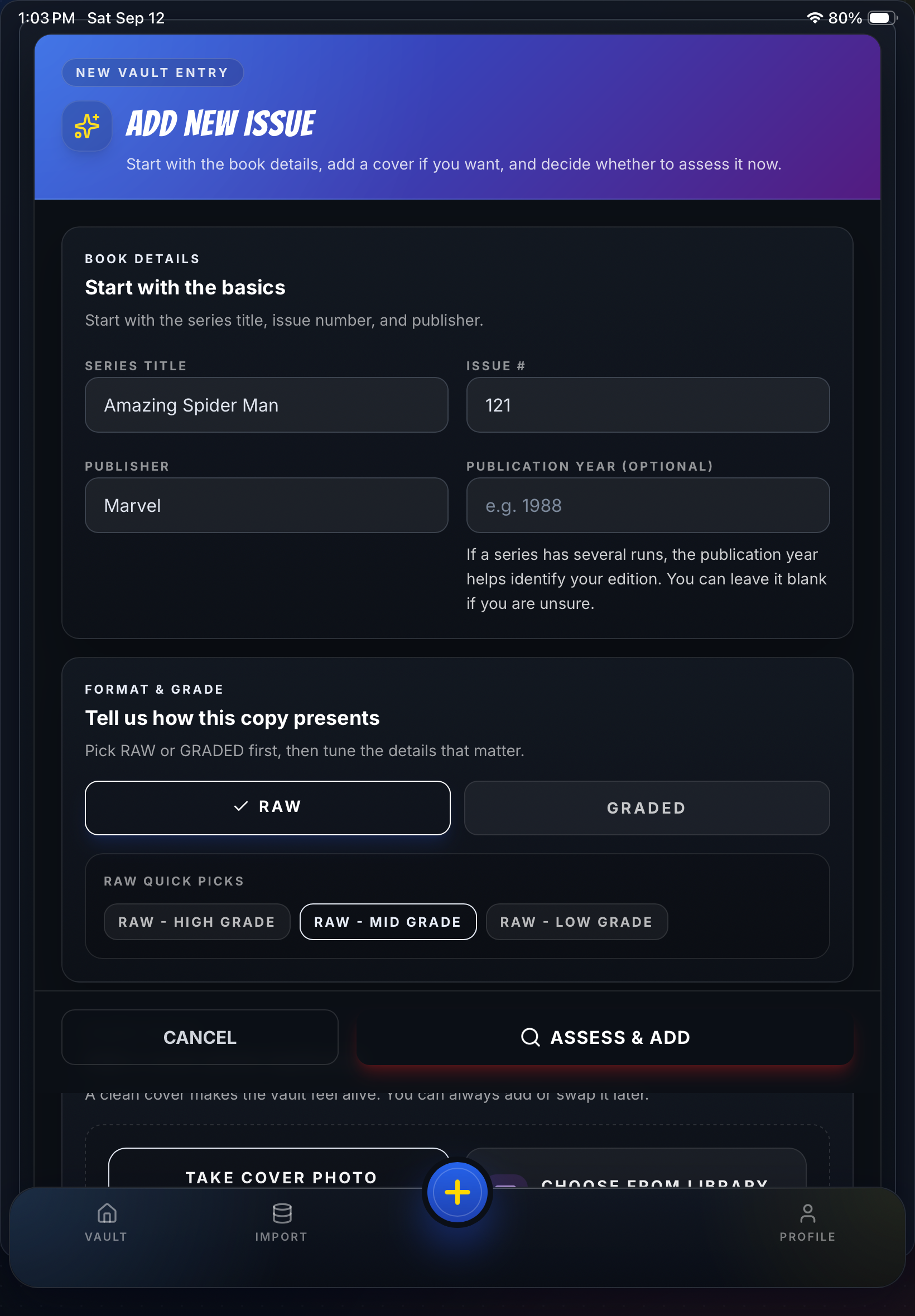
Open ComiCollector and the process starts with the big blue plus button. Tap it and the app opens the Add a Comic form, where you can tell ComiCollector exactly what is going into your collection.
Start with the title, issue number, and publisher. From there, choose the condition of the book. Is it RAW High, RAW Mid, RAW Low, professionally graded, or something else?
If the title has been published across multiple volumes, you can add a specific publication year to help narrow things down. You can also fine-tune the entry for variants and special editions so ComiCollector is looking at the right version of the book.
Graded-book collectors can use ComiCollector’s scroll wheel to select the exact grade of the slab and catalogue the certification number alongside the rest of the book’s details.
Finally, use the built-in cover photo tool to add an image of your copy. That image becomes part of the ComicCard ComiCollector creates for the book, and ComicCards look their best with the actual cover artwork from your collection.
Then the ComiCollector Oracle goes to work
Once you request an assessment, the ComiCollector Oracle takes the information you entered and conducts a market scan.
The Oracle combines ComiCollector’s proprietary valuation database with current market evidence where available, while taking into account the details that actually matter: title, issue, grade, raw condition, edition, variant, and other identifying information.
ComiCollector uses AI to assist with parts of that research and analysis, but the system has been built, tested, and curated around the way comic collectors actually think about their books.
The result is not simply a number pulled from a price list. ComiCollector tries to build an assessment around the evidence that exists for your specific copy.
Your book comes back as a ComicCard
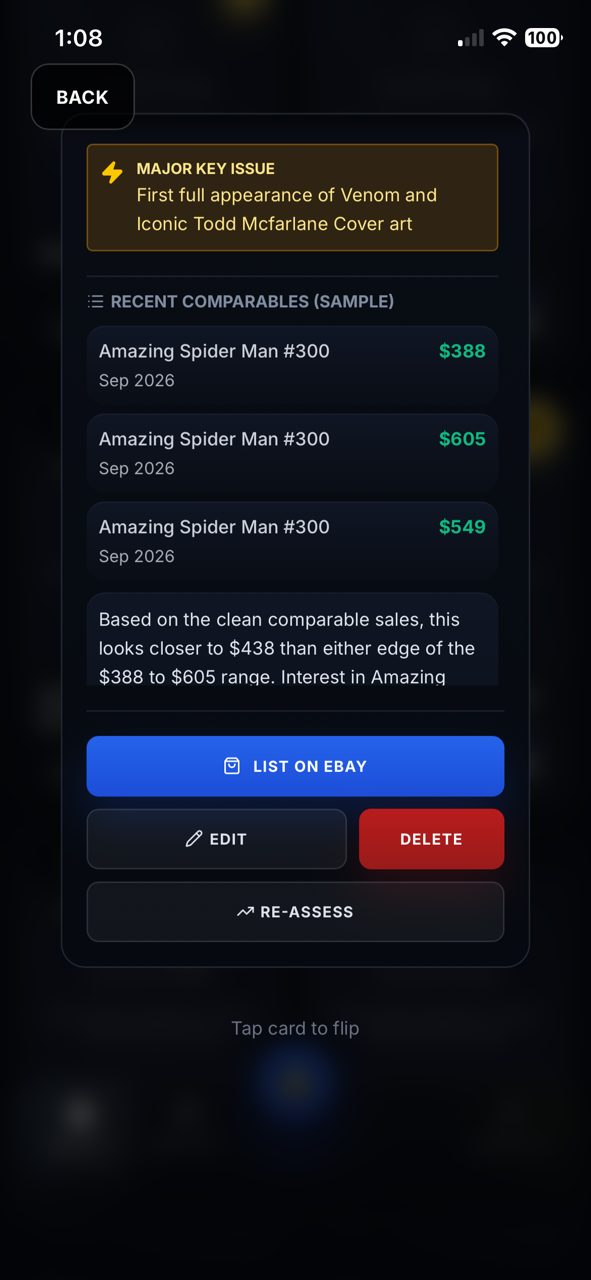
After the assessment is complete, ComiCollector creates a ComicCard for the book.
The ComicCard becomes the central record for that issue inside your collection. It includes the assessed value, key-book information, market context, and the details you entered when cataloguing the comic.
If the book is a key, ComiCollector identifies that and explains why. That might mean a first appearance, an important story event, a major character moment, or another reason the issue matters to collectors.
For graded books, ComiCollector can also identify scarcity information, helping put that particular graded copy into better context.
Assessments can also return recent comparable market evidence, so you can see some of the information behind the valuation instead of being handed a mystery number with no explanation.
Market Insights explain what the most recent sale cannot
Every comic market has noise.
A raw copy advertised as “high grade” can appear across a wide range of prices depending on its actual condition, the quality of the listing, the seller, the timing, and the mindset of the person buying it.
One motivated buyer can create a useful data point. That does not automatically establish the market for every other copy of that book.
That is why ComiCollector assessments include a personalized Market Insight note. Market Insights are designed to explain what is happening around the book rather than simply repeating the assessed value.
When the evidence supports it, ComiCollector can identify the broader price range, the centre of the available market evidence, and unusual high or low observations that deserve context.
The idea is to help collectors separate actual market signals from speculation, hype, outliers, and listings that may not tell the whole story.
Why one number never tells the whole story
Comic values can look straightforward until you actually try to price a book.
Condition alone can move the value dramatically. So can grading, edition, scarcity, demand, and the quality of the available comparable evidence.
That becomes even more important with big books and grails.
Some comics simply do not trade often. When exact comparable evidence is limited, pretending there is a perfectly precise market price would be misleading.
For those thin-market books, ComiCollector can widen the assessment range to reflect the uncertainty in the available evidence. The Oracle works from the strongest relevant market information it can verify and uses that evidence to help collectors understand the book they own — or the one they may be thinking about buying.
The goal is not to force every comic into one magic number. The goal is to give collectors an assessment that reflects the market evidence that actually exists.
Watch the market with Market Pulse
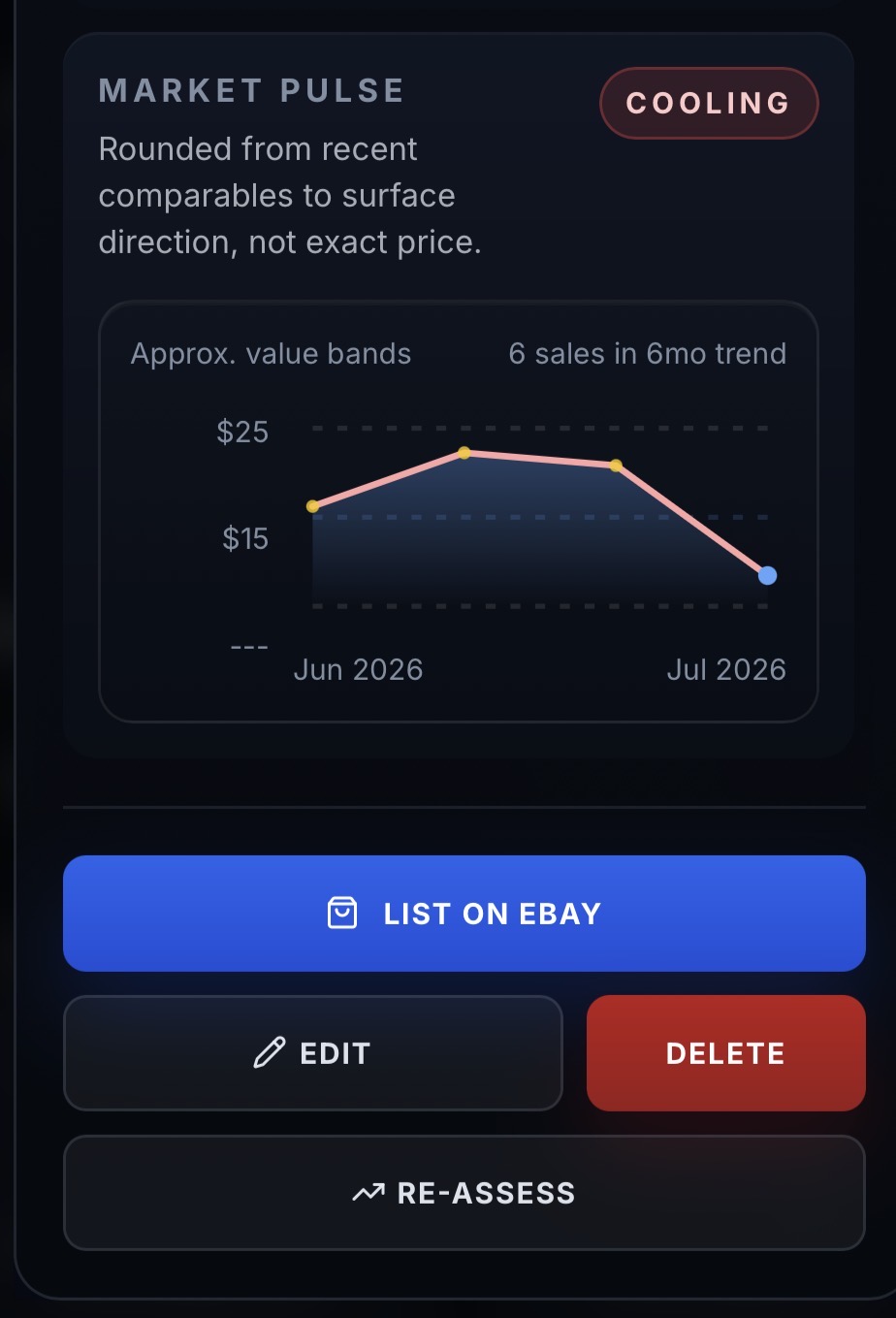
Where enough historical data is available, ComiCollector also provides a Market Pulse chart.
Market Pulse gives collectors a quick visual look at recent pricing activity for the issue, making it easier to see whether the market has been relatively stable, moving upward, cooling off, or producing a lot of noise.
ComiCollector’s proprietary valuation database continues to grow as more market evidence is collected and analyzed, which means the app can build a deeper picture of more books over time.
And if the book is leaving the collection...
Sometimes an assessment confirms exactly what you thought: the book is staying in the collection.
Other times, it may be time to make room in the short box.
ComiCollector includes built-in eBay integration for verified sellers on eBay’s platform. Once a book is catalogued, eligible sellers can use the information already stored in ComiCollector to prepare a listing without starting from scratch.
The app can also suggest listing text, making it easier to prepare a comic for sale.
That means the same app you use to catalogue, assess, and understand your comic can also help you manage it when you decide the book is leaving the collection.
One collection. One vault.
ComiCollector is not trying to turn comic collecting into a spreadsheet.
The whole point is to make it easier to know what you have, understand why a book matters, follow its market, document your collection, and decide what you want to do with it next.
Because collecting is not just about the number printed beside a book.
It is about the hunt, the history, the cover, the grade, the key issues, the books you refuse to sell, and the ones you cannot believe you finally found. And it feels even better when you understand how the price you paid compares with the current market.
Welcome to the future of collecting.