The Vault Gazette
How to Catalogue a Comic Book Collection
Long boxes. Short boxes. Slabs. Variants. Readers. Grails. You know your collection is full of great books, but do you really understand what you have?
Every collector eventually reaches the same point.
You know the big books. You know the wall books. You probably know exactly where that one issue is that you spent three years hunting down.
But then the collection grows.
A few conventions become a few dozen. Online orders show up. Dollar-bin books multiply. You upgrade a copy but forget to remove the old one. Variants sneak in. Slabs take over a shelf. Somewhere along the way, memory stops being a reliable cataloguing system.
So... what exactly is it that I own?
That is the real reason to keep a detailed catalogue of a comic collection.
Not because collecting needs more paperwork. Because knowing what you own makes the hobby easier. You can find books faster, avoid accidental doubles, keep an eye on values, document the collection for insurance, and know exactly what is in the vault when the next want-list opportunity comes along.
Start with the big blue plus button
This is why we invented ComiCollector: a cutting-edge platform that lets collectors dive deeper into their collections.
The process begins with the big blue plus button. Tap it and the Add a Comic form opens. From there, you can build a proper record for the specific copy sitting in front of you.
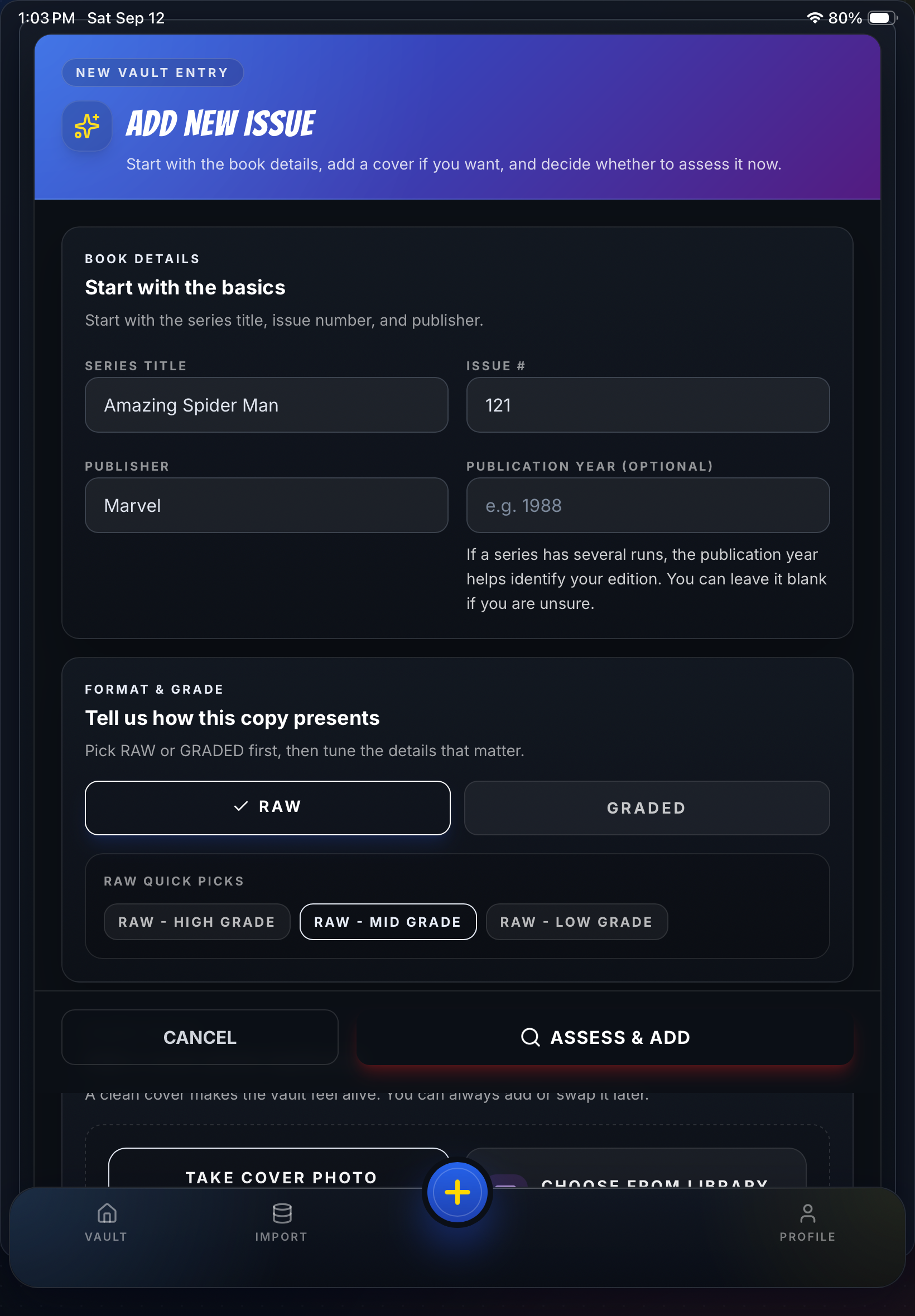
Begin with the identifying information:
- Title
- Issue number
- Publisher
- Publication year, where it helps distinguish different volumes
- Variant or special-edition details
Then record the condition. A comic catalogue is only useful when it describes the book you actually own, not just the issue that appears on the cover.
Is it RAW High, RAW Mid, or RAW Low? Is it professionally graded? Does it have a certification number? Is it a variant that deserves its own entry?
These distinctions prevent one of the most common collection mistakes: treating every copy of an issue as though it were interchangeable.
Catalogue the copy, not just the comic
“Batman #1” or “Amazing Spider-Man #300” tells you what the book is. It does not tell you which version is in your collection.
A raw reader, a high-grade raw copy, a signed book, a variant cover, and a CGC 9.8 slab may all share the same basic issue number. They should not be treated as the same asset.
ComiCollector gives raw books useful condition categories without forcing you to invent a false level of precision. RAW High, RAW Mid, and RAW Low provide practical context for ungraded books.
For graded comics, the scroll wheel lets you select the exact grade of the slab and store the certification number alongside it.
That information becomes especially valuable when you own multiple copies. Instead of wondering which book is which, you can identify the copy by its condition, grade, certification, variant details, and photograph.
Photograph the book in your hands
A catalogue becomes much easier to use when it includes images of the actual collection.
ComiCollector includes a built-in cover photo tool, allowing you to add a picture of the book you own rather than relying only on a generic issue image.
This is particularly useful for:
- Multiple copies of the same issue
- Variant covers
- Signed books
- Raw books with noticeable condition differences
- Books that have been upgraded over time
The image becomes part of the ComicCard, giving you a visual reference whenever you browse the vault. It also makes the collection feel like your collection, not a list copied from a price guide.
Build a ComicCard for every important detail
Once you add a book, ComiCollector creates a ComicCard for it.
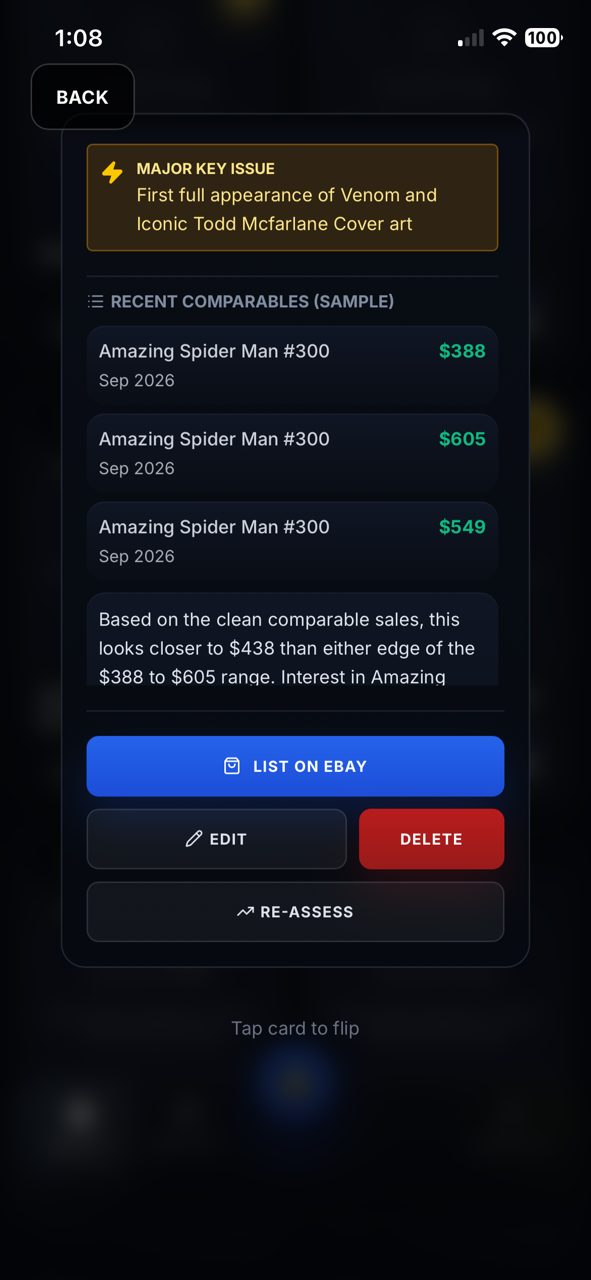
The ComicCard is where the record becomes useful. It brings the book's identity, your ownership details, its image, and available market information together in one place.
Depending on the issue, the ComicCard may include:
- Title, issue number, publisher, volume, and edition information
- Your photograph of the cover
- Raw condition or graded-book details
- Certification information
- An assessed value
- Major Key or Minor Key status
- Information explaining why the issue matters
- Scarcity information for graded books where available
- Market information and comparable evidence
- Market Insights from a ComiCollector assessment
Use the catalogue to answer collector questions
The best catalogue is not the one with the most fields. It is the one that answers the questions you actually ask while collecting.
Have I read this issue? Is it a key? Is it graded? Is it listed for sale? Is this the copy I bought last month, or the older copy I meant to replace?
ComiCollector uses visual badges and status information to make those answers easier to see while browsing your collection.
That means you can scan the vault and understand more without opening every ComicCard individually.
Separate the collection by purpose
Physical storage and digital organization do not have to follow the same rules.
Your books might be stored by publisher, character, era, or box size. Your digital vaults might be organized by purpose instead.
You could create vaults for:
- Long-term collection books
- Grails and major keys
- Books waiting to be graded
- Books for sale
- Reading copies
- Silver Age, Bronze Age, or modern books
- Variants and special editions
ComiCollector lets you create and name your own vaults, so the digital structure can match the way you think about your collection.
Catalogue before the next convention
A collection catalogue is most useful when you are away from the collection itself.
At a convention, a comic shop, or a flea market, you may find a book that looks familiar. The cover rings a bell. The issue number sounds right. You cannot remember whether you already own it.
A quick search can save you from buying the same comic twice.
It can also help you make better decisions about upgrades. If you already own a lower-grade copy, you can decide whether the new book is genuinely better or simply another version of something already in the box.
Keep value information with the book
A comic's value is not determined by the issue number alone.
Condition, grade, variant status, scarcity, market activity, and the specific copy all influence how collectors understand its worth.
ComiCollector assessments bring available market information and comparable evidence into the ComicCard, giving you more context than a single disconnected price estimate.
Values can change. That is why the catalogue should be treated as a living record rather than a permanent declaration of what every book is worth.
Make the collection easier to document
Once a collection contains valuable keys, slabs, vintage books, or years of purchases, documentation becomes important for more than convenience.
ComiCollector can generate Insurance Ready PDF documentation containing collection details and assessed values. This can give you a clear starting point when discussing the collection with an insurance provider.
It does not replace an insurer's requirements or a formal appraisal. It does, however, provide a much stronger record than trying to remember every book after a loss.
Update the catalogue when the collection changes
Do not wait until the collection is perfect. Comic collections are never perfect, and they are never finished.
Add books as they arrive. Photograph them while they are in front of you. Update a raw copy if it is graded. Mark books as read. Move books between vaults. Record the copy you sold instead of leaving an outdated entry behind.
The more current the catalogue is, the more useful it becomes.
ComiCollector is built for that ongoing process: adding, assessing, organizing, tracking, and updating the collection as it develops.
When a book becomes a sale
Not every comic stays in the permanent collection.
Some books are duplicates. Some are upgrades. Some were bought with the intention of selling them later. Others simply no longer fit the direction of the collection.
ComiCollector includes built-in eBay integration for verified sellers on eBay's platform. Eligible sellers can use information already stored for a book to help prepare an eBay listing without starting from an empty form.
ComiCollector can also suggest listing text, helping turn an existing ComicCard into a useful starting point for a sale.
Once listed, the book can be identified in your collection so you know which comics are currently available and which ones remain in the vault.
A catalogue should give you confidence
The point of cataloguing is not to make collecting feel like administration.
It is to remove uncertainty.
You should know which books you own, which copies are graded, which variants are in the collection, what you have read, what is listed for sale, and where the important books are stored.
You should be able to look at a ComicCard and understand the story of that copy: what it is, why it matters, what condition it is in, what it may be worth, and how it fits into the rest of the vault.
That is what turns a pile of comics into a collection you can manage.
ComiCollector gives you the tools to build that record one book at a time — with covers, grades, keys, values, variants, reading status, sale status, and the details that make your collection yours.